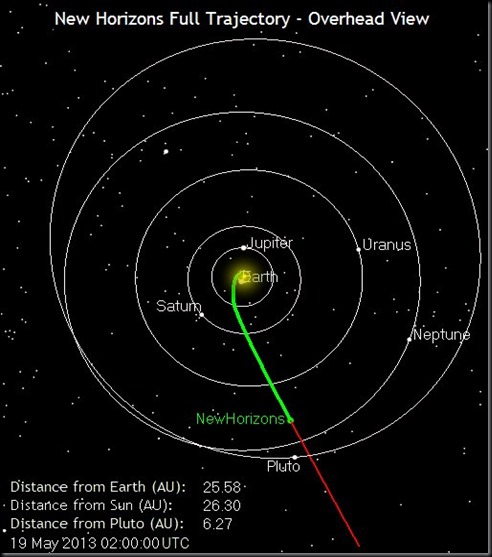
Sunday, June 16, 2013

New Horizons Mission Update 6/16/13


NH spacecraft at Pluto

Mission Elapsed Time:
Beginning 1/19/06  19:00:00 UTC
2705 Days (7.41 yrs.) 06 Hours 11 Minutes

Pluto Closest Encounter
Operations Begins:
4/12/15 00:00:00  UTC
636 Days (1.74 yrs.) 22 Hours 47 Minutes

Pluto Closest Approach:
7/14/15 11:49:59 UTC
757  Days (2.03 yrs.) 10 Hours 36 Minutes


New Horizons Team Sticking to Original Flight Plan at Pluto:

Unless significant new hazards are found, expect NASA’s New Horizons spacecraft to stay on its original course past Pluto and its moons, after mission managers concluded that the danger posed by dust and debris in the Pluto system is less than they once feared.


NH pluto_geometry_large2


The New Horizons team recently completed an 18-month study of potential impact hazards – mostly dust created by objects hitting Pluto’s small satellites – the spacecraft would face as it speeds some 30,000 miles per hour (more than 48,000 kilometers per hour) past Pluto in July 2015. The team estimated that the probability of a mission-ending dust impact was less than 0.3 percent if the spacecraft followed the current baseline plan, far below some early, more conservative estimates. So, with the concurrence of an independent review panel and NASA, the project team expects to keep New Horizons on this baseline course, which includes a close approach of about 12,500 kilometers (nearly 7,800 miles) from the surface of  Pluto.


NH pluto_encounter3_tn

“We found that loss of the New Horizons mission by dust impacting the spacecraft is very unlikely, and we expect to follow the nominal, or baseline, mission timeline that we've been refining over the past few years,” says New Horizons Project Scientist Hal Weaver, of the Johns Hopkins University Applied Physics Laboratory. “Still, we'll be ready with two alternative timelines, in the event that the impact risk turns out to be greater than we think.”

NH Pluto-System

Safe passage: With the dust-impact hazard less than once feared, the New Horizons team plans to keep its spacecraft on the baseline trajectory through the Pluto system.


Those alternate plans (called SHBOTs, short for Safe Haven by Other Trajectories) are being developed should new information – gathered from New Horizons camera observations during the approach to Pluto, for example, or new dust-dynamics analyses – indicate less-than-smooth sailing for New Horizons.  New Horizons managers recently presented their impact-hazard outlook and if-necessary mitigation plans to an independent NASA review panel and to the NASA Science Mission Directorate Program Management Council  and   received endorsements from both.

New Horizons Course and Position in Three Dimensions:

#1

NH #1

#2

NH #2

#3

NH #3


New Horizons Principal Investigator Alan Stern, of the Southwest Research Institute, says the mission team is now finalizing plans for the Pluto encounter. In early July, the team will rehearse the most critical nine-day segment of the baseline encounter plan, putting itself and the spacecraft through the paces of the flight toward and just past Pluto and its moons. Stern adds that the spacecraft remains on target for a close approach to Pluto in 2015, all subsystems are performing nominally, and “the anticipated science observations will revolutionize our understanding of dwarf planets and the Kuiper belt, and excite a whole new generation of the public to the first reconnaissance of a planet on the very frontier of our solar system

Sunday, May 19, 2013

New Horizons Mission Update 5/19/13


NH science pay load


Mission Elapsed  Time:
Beginning 1/19/06 19:00:00 UTC
2677 Days  (7.33 yrs.)  07 Hours 44 Minutes

Pluto Closest Encounter Operations Begin:
4/12/15 00:00:00 UTC
628 Days (1.72 Yrs.)  21 Hours 27 Minutes

Pluto Closest Approach:
7/14/15 11:49:59 UTC
785 Days (2.15 yrs.) 09 Hours 17 Minutes


Waking Up New Horizons for Summer 2013:


Currently, New Horizons itself is about 2.6 billion miles from the Sun, and only about 600 million miles from Pluto. Arrival at Pluto is just under 700 days away – still a long time, but much less than the nearly 2,700 days New Horizons has been traveling since launch.  New Horizons is healthy and on course, with all systems and science sensors working. On May 21, the team wake the spacecraft from its most recent, 100-plus day hibernation to begin a busy annual checkout, which will include thorough checks of all backup systems, instrument payload calibrations, and an update of the fault protection software with the next-to-last planned set of enhancements before New Horizons starts the Pluto encounter in January 2015 – just over 19 months from now.

New Horizons Present Position in Three Dimensions:

#1:

NH pos #1

#2:

NH Pos #2

#3:

NH Pos #3


This summer’s wakeup will also include the most comprehensive on-the-spacecraft close-encounter rehearsal.  For nine days, beginning July 5, New Horizons will execute all the activities of its final week on approach to Pluto, closest approach day, and then some of the post-encounter timeline as well.  After the nine-day rehearsal, New Horizons will be ordered to downlink a large amount of data through NASA’s Deep Space Network to evaluate how the rehearsal went, collect more cruise science data, conduct more spacecraft navigation tracking, and then put New Horizons back into hibernation on August 21 for another 4½ months,  Also this summer, New Horizons will be close enough to resolve Pluto from its large moon Charon using the long-focal length telescopic imager called LORRI. The first week of July is also the 35th anniversary of Charon’s discovery and – entirely by coincidence – the spacecraft will be taking our first images of Charon at the same time of year that the moon was discovered, back in 1978.  There won't be a course correction this summer as in 2011 and 2012. The spacecraft navigation team has determined from tracking data that New Horizons is  on course and that there is no need to expend any fuel over this issue.  The mission team will feel the increased pace of activity as the spacecraft draws closer and closer to 2015, and many members of the team are working much longer hours on this project than they did in early- and mid-cruise phases of the mission. To prepare for encounter operations to start in January 2015, new staff will be added to the science and operations teams. In fact,   one very important addition was added by bringing in a deputy project manager, Peter Bedini, of the Johns Hopkins Applied Physics Laboratory.


NH alternate flybys #1

The New Horizons team studied numerous alternate flybys, called SHBOTs, before recommending to NASA a pair of backups to protect New Horizons from possible impact hazards in the Pluto system.

All exploration comes with both rewards and risks:

Back in 2005 and 2006, when Pluto’s second and third moons (Nix and Hydra) were discovered, searches by astronomers for still more moons didn’t reveal any. So the accidental discovery of Pluto’s fourth moon by the Hubble Space Telescope in mid-2011 (during a search for Plutonian rings) raised the possibility that the hazards in the Pluto system might be greater than previously anticipated. Those concerns were amplified when Hubble discovered a fifth moon in 2012. As a result of those discoveries, the New Horizons science and operations teams began to more carefully scrutinize the true level of hazards to the spacecraft at closest approach and devise mitigation strategies to make sure the encounter with Pluto would be successful.
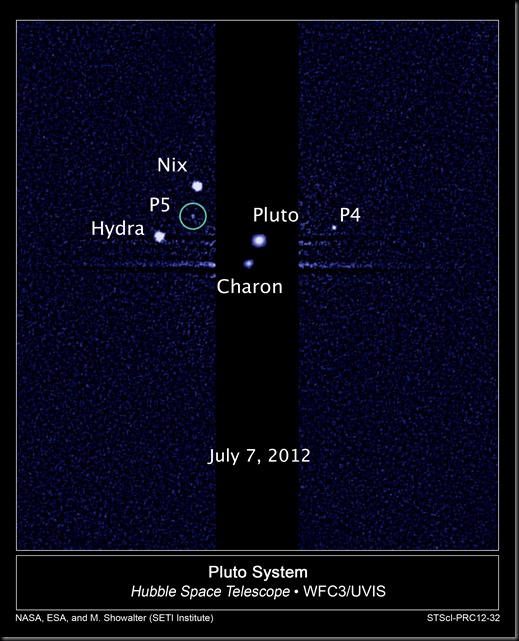
NH Pluto system.


A survey was completed by NASA and an independent group-a NASA approved technical review team, led by the Jet Propulsion Laboratory’s Keyur Patel, and then by senior executives at NASA Headquarters. Both groups have concurred with the team's findings, which can be surmised as follows:

1. New Horizons benefits from its approach trajectory because that trajectory is steeply inclined to Pluto’s satellite plane and associated debris hazards that models show should lie close to the satellite plane. As a result, most of the risk New Horizons faces occurs only at closest approach, when the spacecraft is very near the satellite plane.


NH Trajectory #2

The New Horizons trajectory (red line) is steeply inclined to Pluto’s satellite plane, thereby restricting satellite debris hazards – which lie near the satellite plane – to the short time near closest approach.

2. The Pluto system appears to be far safer than early fears and initial calculations indicated when the new moons began popping up. In fact, the best current models predict a 0.3% (1-in-300) chance of a mission-ending impact near closest approach on the nominal trajectory. Much of the reason for this lowered risk assessment is that more sophisticated dust-impact models revealed a decrease (by about a factor of 100) in lethal impact probability for trajectories that fly into the region where New Horizons is aimed now – a region where the gravitational effects of Pluto’s largest moon Charon clears debris. Another important factor is that when the team tested spacecraft components against high-velocity impacts using gun ranges in New Mexico and Ohio, it was discovered that the spacecraft shielding is considerably “harder”– that is, more resistant to impacts – than preflight estimates indicated.

3. The base lined New Horizons closest-approach aim point is one of the safest possible aim points – if not the safest aim point – in the Pluto system. This is because New Horizons is headed to a closest approach in the region that Pluto’s Texas-sized moon Charon efficiently clears of debris. In fact, Charon offers such a good hazard-removal service that even if a recent impact onto a small moon created debris near Charon’s orbit just months before encounter, Charon would clear almost all of it by the time the spacecraft arrives.

But to be still more prudent, the team is also implementing plans during the final weeks of approach in summer 2015 for New Horizons itself to search for hazards that can’t be  seen from Hubble or Earth-based telescopes. Then the team also added “fail safe” data downlinks just two days and one day before the encounter to send home the best images and spectra stored on the spacecraft’s recorders, just in case the current estimates are wrong and  New Horizons is lost at closest approach. It’s always better to plan this way, just as the Apollo astronauts collected contingency samples right after stepping onto the moon in case they had to make a hurried getaway before their moonwalks could be completed.  And – just as every space shuttle mission included (but never used) plans to land after just one orbit of Earth if the spacecraft wasn’t healthy enough to continue – there are two alternate encounter sequences that  can be uploaded to New Horizons as late as 10 days before the closest approach, in the unlikely event that  hazard observations on final approach raise new cautions.

Safe Havens:

These backup encounter sequence plans are called SHBOTs, an acronym for Safe Haven By Other Trajectory.  The first SHBOT is called GIS, for Generic Inner SHBOT. It continues on the nominal trajectory and aim point, but for three hours near closest approach, then  the spacecraft is repointed so its dish antenna can shield it from impacts. This pointing attitude, called Antenna to Ram (or ATR), would cost  some science because the spacecraft won’t be as free to point the science instruments toward Pluto system targets during those three hours. But tests and modeling show this provides a factor of three to four times increase in success probability, and reduces the estimated loss of mission probability to about 1 in 1,000.


NH picture #3

If necessary, the high-gain (“dish”) antenna on New Horizons can be used to shield most of the spacecraft from dust particle impacts during the Pluto encounter.

The second SHBOT is called DIS, for Deep Inner SHBOT. DIS also uses the ATR attitude. It also directs the spacecraft toward a much closer encounter with Pluto – just inside 3,000 kilometers from Pluto’s surface, compared to the nominal encounter close approach of about 12,500 kilometers from the surface. Why go closer, not farther, to avoid hazards? Because if the spacecraft  goes close enough, it can benefit from the fortuitous “drag clearing” of debris particles from Pluto’s extended upper atmosphere. DIS has more severe science impacts than does GIS, but there is a strong consensus among the team members that it’s both the best choice if late-breaking news tells them the nominal trajectory is unexpectedly riskier than anticipated, and losing some science to execute Deep Inner SHBOT is far better than losing the mission to a lethal impact.   When  launched it was never imagined that the team would be planning three separate encounters with Pluto, but that is what has happened.

Thursday, May 9, 2013

New Horizons Mission Update 5/9/13


New Horizons going through debris fielld


Mission Elapsed Time:
(Beginning 1/19/06 19:00:00 UTC)
2667 Days (7.31 yrs.) 06 Hours 14 Minutes

Pluto Closest Encounter Operations Begin:
(4/12/15 00:00:00 UTC)
701 Days (1.92 yrs.) 22 Hours 45 Minutes

Pluto Closest Approach:
(7/14/15 11:49:59 UTC)
795 Days (2.18 yrs.) 10 Hours 34 Minutes


New Horizons Current Position and Course in Three Dimensions:

#1

NH Pos #1

#2:


NH POS #2

#3:


NH POS #3


A new companion for Neptune:

Alex Parker and associates  describes a serendipitous discovery that his collaborators and he made while searching for a distant Kuiper Belt Object for the New Horizons spacecraft to visit after its 2015 Pluto flyby.


New horizons candidate logo


So, what kind of serendipitous discovery did they make? They found a Neptune Trojan, now called 2011 HM102.  It is  not just any Neptune Trojan:  It's the largest trailing Trojan known in the entire Solar System, it's the most inclined Neptune Trojan known, and (as of right now) it is the closest known object of any kind to the New Horizons spacecraft


Trojans in the Solar System:


Trojan asteroids are objects in 1:1 mean-motion resonance with a planet, meaning that they orbit with (nearly) exactly the same period as the planet. There are different semi-stable orbital configurations for objects in 1:1 mean-motion resonance, and Trojans are objects which fall into two of these configurations - namely, they lead or trail the planet in its orbit by (on average) about 60 degrees. Objects leading the planet oscillate around the planet-Sun are called the  L4 Lagrange point, while objects trailing the planet oscillate around the planet-Sun are called the L5 Lagrange point. This kind of orbital oscillation is called "liberation."


NH Trojan 2011 comparison


The distant ice-giant Neptune has nine known stable Trojans. While at first glance it might seem that since we know of more than 5000 Trojan companions for Jupiter and only nine for Neptune, we can give Jupiter the award for having the most Trojans today.   Neptune is much farther away from us than Jupiter, and it is much harder to detect small objects (like Trojans) at Neptune's distance than it is at Jupiter's. Early estimates correcting for this effect indicate that Neptune's Trojan swarms may have upwards of 10 times as many objects in them as Jupiter's swarms, or equivalently 10 times as many objects as reside in the Main Asteroid Belt.  The trick is finding these distant, slow-moving, and exceedingly faint objects. Which brings us to why were they at the telescope when they found 2011 HM102? Well, we have a spacecraft called New Horizons and it is planned that after its successful run at Pluto it will take a look at some KBOs already picked out ahead of time.  New Horizons is currently flying out to meet Pluto at a breakneck speed of over 13 kilometers per second. In July of 2015, it will fly through the Pluto system, collecting as much data as it can with its onboard instruments, and then beam all that information back to Earth. However, there's no stopping New Horizons at Pluto. The spacecraft will continue outward into the Kuiper Belt at that incredible speed, with enough fuel left onboard for a small course change.  The goal is to find a small Kuiper Belt Object (KBO) for New Horizons to study once it has completed its primary mission to Pluto. Because of its limited remaining fuel supply, it can only make a small course change, meaning that it can only reach a very small slice of the outer Solar System. However, the outer Solar System is filled with billions of small, icy objects, and a few of these may be the perfect candidates they are looking for.


NH kbo target map


Astronomers conducting surveys for KBOs usually pick fields far away from the Galactic plane to avoid dealing with images filled to the brim with boring old stars. So, unfortunately, that means they have to do a special survey, and they got to deal with the nightmare that is dredging through these star fields for moving objects.  Starting in 2011, they have been turning these telescopes and their giant imaging arrays toward the patch of sky where they expect to find the Kuiper Belt objects that New Horizons can reach.


NH KBO search photo


Once these images have been collected the images are scrutinized for targets. Special techniques are applied  that remove stationary objects (like stars) and reveal moving objects (like Kuiper Belt objects).


Discovery of 2011 HM102:

Their survey beam punched right through Neptune's trailing Trojan cloud.   The survey was not designed specifically to find Neptune Trojans – though they were aware that they could find them  During the normal search process, they spotted 2011 HM102 as fast-moving and very bright - it's the brightest object discovered to date by a wide margin.


NH discovery of 2011 HM102


Using the updated orbit, a large number of simulations were run to determine how stable 2011 HM102 was, and found that for at least a billion years, 2011 HM102 happily continues to remain in its resonant configuration with Neptune.  Because 2011 HM102 is quite bright (compared to the other objects they had been finding), they could also measure it's color. This is done by collecting images of the object through various color filters, and comparing how bright it appears in one color filter versus another. This was the first measurement of the color of a trailing Neptune Trojan, and it was demonstrated that it has a very similar color to the leading Neptune Trojans.


NH diagram kuiper belt fly through


They recognized one other interesting aspect about 2011 HM102: it comes fairly close to New Horizons position as it heads for Pluto.   As of right now, it is the closest known object of any kind to New Horizons - about 2.5 AU away. In the later parts of 2013, it will pass within 1.2 AU of New Horizons, where it will be bright enough to be just detectable from New Horizons.


NH decides not to photo Trojan 2011

Saturday, January 12, 2013

New Horizons Mission Update 1/12/13


NH spacecraft at Pluto


Mission Elapsed Time:
Beginning 1/19/06  19:00:00 UTC
2,549 Days (6.98 yrs.) 09 Hours 28 Minutes

Pluto Closest Approach Operations Begin:
4/12/15  00:00:00 UTC
819 Days (2.24 yrs.) 19 Hours 39 Minutes

Pluto Closest Approach
7/14/15  11:49:59 UTC

913 Days (2.50 yrs.) 07 Hours 28 Minutes


New Horizons Gets a New Year’s Workout

Like many of us, New Horizons is starting the new year with a workout regimen. After six months of cruising quietly through the outer solar system, NASA’s Pluto-bound spacecraft came out of hibernation last weekend for three weeks of activity that include system checks, a new flight software upload and science data downloads.


Outersolarsystem_objectpositions_labels_comp

Map of Outer Solar System (with Kuiper Belt Objects)


The mission operations team at the Johns Hopkins University Applied Physics Laboratory (APL) in Maryland “woke” New Horizons from electronic slumber on Jan. 6. First tasks included evaluating real-time spacecraft data (which indicated New Horizons was in good health), sending operating commands to the spacecraft’s main computer, and gathering tracking data that will help the navigation team keep New Horizons on course toward the Pluto system. Operators are communicating with New Horizons through NASA’s largest Deep Space Network antennas in Spain, Australia and the U.S. (California).


NaSA DSB MADIRID

NASA DSN in Madrid, Spain


Starting today, through Jan. 12, the team will upload new software for the Command and Data Handling (C&DH) system, an upgrade that addresses a cause of resets in the spacecraft’s computer. If you can’t wait mere minutes to download a new app, this will make you cringe: With radio signals needing nearly 3 hours and 40 minutes to reach the spacecraft – which is about 2.4 billion miles (3.9 billion kilometers) from Earth, between the orbits of Uranus and Neptune – the full software upload will take about 44 continuous hours, says New Horizons Mission Operations Manager Alice Bowman, of APL. “The Mission Operations Center must remain in constant contact with New Horizons in case the unexpected happens, despite the numerous preparations and precautions the team has taken,” Bowman says.

C&DH: The Brains ‘Inside’ New Horizons

The command and data handling system – a radiation-hardened 12-megahertz Mongoose V processor guided by intricate flight software – is the spacecraft’s “brain.” Radiation hardening is the act of making electronic components and systems resistant to damage or malfunctions caused by ionizing radiation (particle radiation and high-energy electromagnetic radiation),  such as those encountered in outer space.


NH Mongoose V

Radiation Hardened 12 Megahertz Mongoose V Processor


The processor distributes operating commands to each subsystem, collects and processes instrument data, and sequences information sent back to Earth. It also runs the advanced “autonomy” algorithms that allow the spacecraft to check the status of each system and, if necessary, correct any problems, switch to backup systems or contact operators on Earth for help.  “I think of the C&DH system software update as a ‘tune-up’ at the 2.4 billion-mile marker,” says APL’s Glen Fountain, New Horizons project manager.


SWAP-PEPSSI_sm

PEPSSI & SWAP


Downloads this month include interplanetary plasma data gathered by the Pluto Energetic Particle Spectrometer Science Investigation (PEPSSI) and Solar Wind Around Pluto (SWAP) instruments, shown above during prelaunch testing. (PEPSSI is at the top.)  Other activities planned over the next 20 days include radio frequency system and Radio Science Experiment checkouts, and a download of cruise science data from New Horizons’ space plasma instruments – SWAP and PEPSSI – which have been studying the charged-particle populations of the outer solar system. Additionally, New Horizons’ solid-state digital recorders (filled with data from last summer’s near-Pluto encounter rehearsal) will be erased in preparation for this summer’s rehearsal of the nine days surrounding Pluto close approach.


New Horizons Current Course and Position in Three Dimensions:

#1

NH Pos 1

#2

NH Pos 2

#3

NH Pos 3


The spacecraft will be put back into hibernation on Jan 3.  New Horizons has spent about 80 percent of the past five years in hibernation, a low-power mode that reduces operation costs, frees up Deep Space Network tracking resources for other missions and lessens wear and tear on spacecraft electronics. During the past two years, this hibernation mode has been enhanced to enable New Horizons to collect plasma science data in interplanetary space. The team wakes New Horizons two or three times a year to check systems and run tests, but after May 2014 the spacecraft will remain “on” without hibernating through the 2015 Pluto encounter.

Wednesday, November 28, 2012

New Horizons Mission Update 11/28/12


NH spacecraft at Pluto


Elapsed Mission Time
Beginning 1/19/06  19:00:00 UTC
2506 Days ( 6.87 yrs.) 07 Hours 22 Minutes

Pluto Closest Encounter Operations Begin
4/12/15   00:00:00 UTC
863 Days (2.36 yrs.) 21 Hours 38 Minutes

Pluto Closest Approach
7/14/15  11:49:59 UTC
957 Days (2.62 yrs.) 09 Hours 28 Minutes


New Horizons is now more than 25 astronomical units from Earth – one AU being the distance between the Earth and sun, 93 million miles or 150 million kilometers.


NH voyager 2 image of Neptune

Voyager 2's Image of Neptune taken 25 years ago


New New Horizons crossed the orbit of Uranus on March 18, 2011. It’ll pass the orbit of Neptune on Aug. 25, 2014 – exactly 25 years after Voyager 2 made its historic exploration of that planet. The distance between the orbits of the two gas giants is about a billion miles.


NH earlly picture of Neptune


New Horizons Early Image of Neptune taken on June 23, 2010


New Horizons will not get very near Neptune so the images it takes of the planet will be similar to the one above.  So far, New Horizons has traveled more than 2.3 billion miles since launch. Pluto itself is a “mere” 711 million miles (1.14 billion kilometers) away from the spacecraft – nearly eight times the distance between Earth and the sun – and currently closer to New Horizons than any other planet.

New Horizon’s Course and Position in Three Dimensions:

#1

NH #1

#2

NH #2

#3

NH #3


New Horizons remains healthy and on course toward Pluto and Kuiper Belt beyond. Mission operators at the Johns Hopkins University Applied Physics Laboratory in Maryland received a “green” beacon transmission from the craft on Nov. 26, indicating all systems were normal. The Solar Wind Around Pluto (SWAP), Pluto Energetic Particle Spectrometer Science Investigation (PEPSSI) and Student Dust Counter (SDC) instruments are currently collecting data while most of New Horizons cruises in electronic hibernation.

1.  SWAP:        NH SWAP instrument 

2.  PEPSSI:

NH PEPSSI instrument

3. SDC:

NH SDC instrument


“This continues to be an essentially textbook cruise to the very frontier of our solar system,” says New Horizons Principal Investigator Alan Stern, of the Southwest Research Institute in Boulder, Colo.  The New Horizons mission operations team will wake the craft in early January for a quick systems checkout, which also includes uploading a software update into New Horizons’ main computer and downloading science data from SWAP, PEPSSI and SDC.